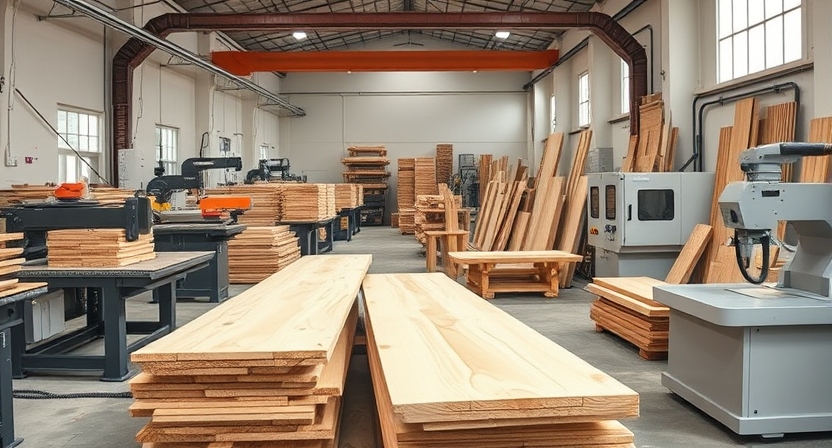
Solid wood furniture manufacturing machines convert timber into accurately sized, shaped, machined, and finished components for products such as tables, chairs, cabinets, doors, frames, and other furniture. A typical factory may use rip saws, crosscut saws, planers, four-side moulders, CNC machines, and sanding equipment, although the exact combination depends on the product and production method.
Unlike panel furniture production, solid wood processing must account for the dimensions, grain direction, condition, and machining requirements of natural timber. As a result, machine selection should follow the sequence in which raw wood becomes a finished furniture component.
How Does Solid Wood Furniture Manufacturing Work?
Solid wood production usually involves several stages rather than one machine completing the entire process.
A simplified workflow can include:
Timber preparation → ripping → crosscutting → planing and dimensioning → moulding or shaping → CNC machining → sanding → finishing → assembly
Not every component follows every stage. A simple rectangular furniture part may require only cutting, dimensioning, drilling, and sanding. A chair component or decorative furniture piece may require profiling, curved machining, multiple drilling operations, and more detailed surface preparation.
The product determines the process.
Rip Saws Prepare Timber to the Required Width
Ripping means cutting wood primarily along its grain. This makes a rip saw an important machine for preparing solid timber before more detailed machining.
Suppose a manufacturer receives boards that are wider than the dimensions required for table rails or cabinet-frame components. A rip saw can divide those boards into narrower workpieces suitable for later operations.
Factories may use different rip-saw configurations depending on throughput, material dimensions, and production requirements.
What Is a Multi-Rip Saw?
A multi-rip saw uses multiple saw blades to make several longitudinal cuts during one feeding process.
This can be useful when a manufacturer repeatedly needs several narrower strips from wider material. However, its suitability depends on the dimensions of the incoming timber and the parts being produced.
The key consideration is not simply cutting speed. Manufacturers also need to think about material utilization, required dimensions, downstream machining, and safe material handling.
Crosscut Saws Establish Component Length
While ripping mainly controls width, crosscutting is used to establish length by cutting across the grain.
Furniture factories often need both processes.
For example, a long timber section may first be ripped to the required width and then crosscut into shorter blanks for legs, rails, frames, or other furniture parts.
Crosscutting can also be incorporated into more structured production systems where components need repeatable lengths.
The required equipment depends on whether the factory handles varied custom pieces or standardized batches of similar components.
Planing Creates Accurate and Consistent Surfaces
After rough cutting, timber often needs to be brought closer to its final dimensions and surface condition.
Planing removes material from a workpiece to produce flatter, smoother, and more dimensionally controlled surfaces. This creates a better starting point for subsequent moulding, CNC machining, joinery, or sanding.
Consistent dimensions are especially important when multiple parts must fit together during furniture assembly.
A table frame, for instance, may contain several rails and legs that need predictable dimensions for joints and alignment to work correctly.
Four-Side Moulders Combine Multiple Machining Operations
A four-side moulder processes several faces of a timber component as it moves through the machine.
Depending on tooling and configuration, the machine can help dimension and profile solid-wood components. It is commonly relevant where manufacturers repeatedly produce mouldings, frame components, strips, rails, or other longitudinal parts.
The advantage is not simply that several sides can be processed. It also allows multiple related operations to form part of a controlled machining sequence.
When evaluating industrial woodworking machinery for solid-wood production, manufacturers should therefore consider how ripping, crosscutting, planing, moulding, CNC processing, and sanding connect to one another. The appropriate machine is the one that fits the material, component geometry, required output, and surrounding manufacturing stages.
CNC Machinery Handles More Complex Components
CNC technology extends solid-wood manufacturing beyond straightforward cutting and dimensioning.
Computer-controlled machinery can perform programmed operations such as routing, drilling, profiling, grooving, and shaping. The exact capabilities depend on the CNC machine’s configuration, axes, tooling, and workholding system.
This is useful for furniture parts that require repeatable but more complex geometry.
Where Is CNC Useful in Solid Wood Furniture?
Potential applications include:
- Chair components
- Table parts
- Door components
- Furniture frames
- Curved or shaped pieces
- Drilled components
- Routed joints
- Decorative profiles
CNC equipment can also be valuable when manufacturers produce several designs because machining instructions can be changed through programming.
However, a CNC machine still needs correctly prepared material. Poorly dimensioned or inconsistently positioned workpieces can make downstream machining more difficult.
For this reason, CNC should be viewed as part of the solid-wood process rather than a replacement for every earlier preparation stage.
How Is Curved Solid Wood Machined?
Not all furniture consists of rectangular components.
Chair backs, armrests, curved table parts, decorative components, and other shaped pieces can require contour machining.
Depending on the design, factories may use CNC machining centers, band saws, profiling equipment, or a combination of processes.
A band saw can remove material to establish a rough curved shape. CNC equipment may then perform more controlled machining where precise programmed geometry is required.
The best method depends on the complexity of the component, production quantity, required accuracy, and amount of finishing needed afterward.
Sanding Prepares Solid Wood for Finishing
Machining establishes the component’s dimensions and shape, but the surface normally requires additional preparation.
Sanding removes machining marks and prepares wood for the desired finish.
Different component shapes call for different sanding methods. Flat surfaces may suit belt sanding, while contoured or profiled furniture parts can require brush sanding or other approaches that follow more complex geometry.
A factory should consider the final surface requirement before choosing sanding equipment.
For example, a component going directly into a basic assembly may have different preparation requirements from a visible tabletop that will receive a high-quality coating.
Dust Extraction Supports the Machining Process
Sawing, routing, moulding, and sanding generate wood chips and dust.
Therefore, dust extraction should be considered when planning a solid-wood production environment. Extraction requirements vary according to the machinery, process, material, and factory setup.
The placement of machines also matters because extraction connections, material movement, operator access, and maintenance space all influence factory layout.
Planning these supporting systems alongside the machinery can produce a more practical production environment than adding them only after equipment has been installed.
Which Machines Does a Solid Wood Furniture Factory Actually Need?
There is no single equipment list for every factory.
A manufacturer should start by mapping the parts it needs to produce.
For each component, ask:
- What form does the raw material arrive in?
- Does it need ripping or crosscutting?
- Must it be planed to precise dimensions?
- Does it require a profile?
- Are holes, grooves, or joints needed?
- Is the component straight or curved?
- What surface quality is required?
- How many similar pieces will be produced?
The answers reveal which processes are necessary.
A factory producing straightforward solid-wood tables may require a very different machine combination from one manufacturing complex chair components or decorative doors.
Build the Process Around the Component
Effective solid wood furniture manufacturing starts with the component rather than with a list of machines.
Ripping establishes suitable widths, crosscutting controls length, planing improves dimensional consistency, moulding creates required profiles, CNC equipment handles programmed machining, and sanding prepares surfaces for finishing. Each stage has a specific role.
Factories can then decide where conventional machinery provides sufficient flexibility and where more automated equipment makes sense.
By matching each machine to the timber, component geometry, production quantity, and next manufacturing stage, manufacturers can build a solid-wood workflow that supports consistent processing without adding equipment that does not solve a genuine production requirement.