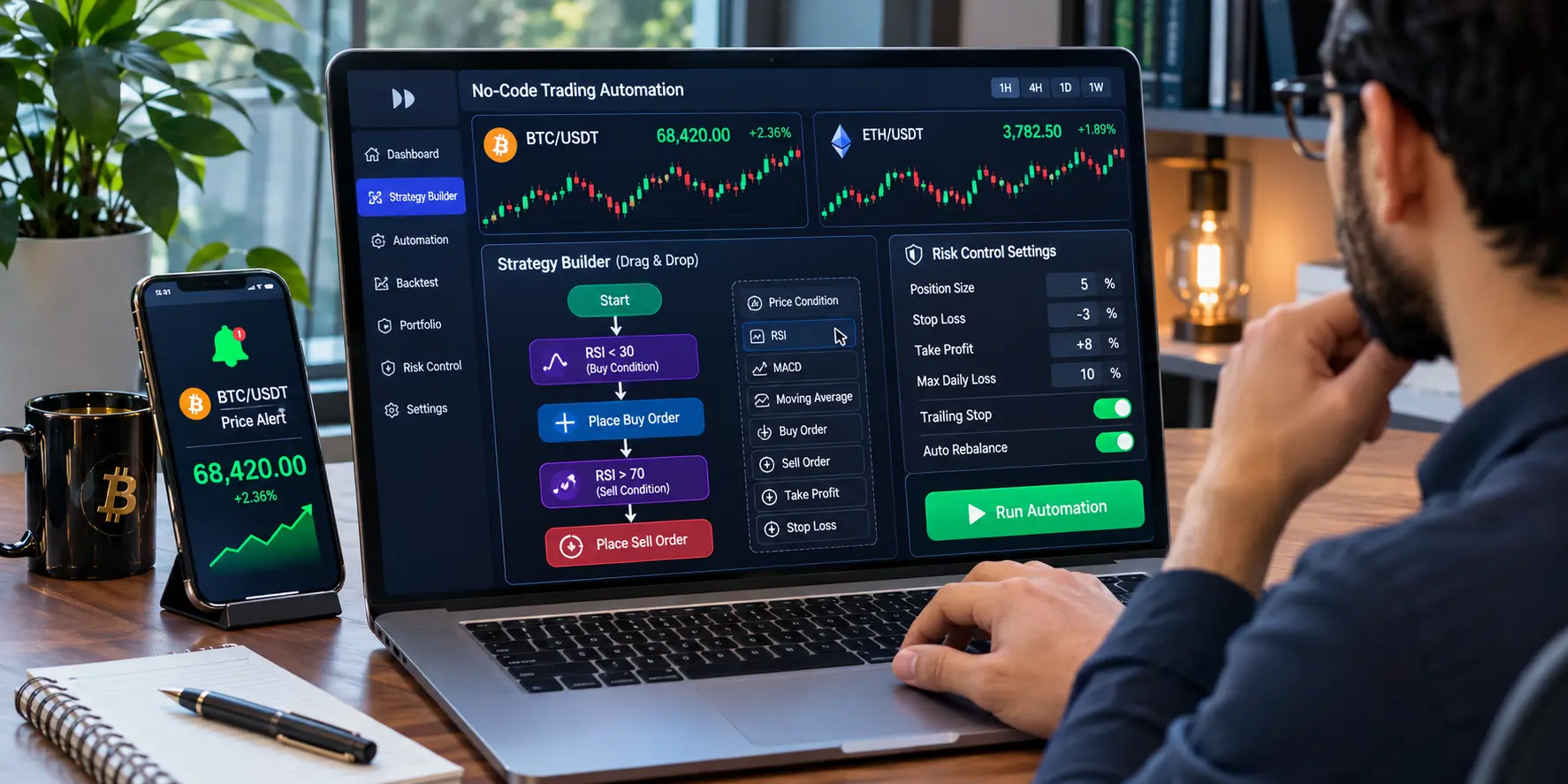
Learning how to automate crypto trading without coding is increasingly practical because many cryptocurrency trading platforms provide visual strategy builders, automated trading bots, and configurable trading rules. Instead of writing programming scripts, investors can use supported tools to monitor prices, generate signals, and execute selected transactions automatically.
However, successful automation requires more than activating a trading bot. Investors must understand exchange connections, strategy settings, trading fees, and risk controls before allowing software to place orders.
This guide explains how no-code cryptocurrency automation works, which tools are available, and what beginners should consider before getting started.
How to Automate Crypto Trading Without Coding: Basic Methods
Learning how to automate crypto trading without coding starts with selecting a suitable platform, configuring simple rules, and testing the strategy before live execution.
No-code crypto trading automation allows users to configure trading activities through graphical interfaces rather than programming languages such as Python or JavaScript.
These platforms typically provide menus, predefined strategies, visual workflows, and adjustable settings.
For example, a user might configure a trading system to monitor Bitcoin and generate an alert when its price crosses a specified moving average.
Depending on the platform, the same condition could trigger an automated buy or sell order.
The main advantage is accessibility. Users can create basic automated workflows without developing custom trading software.
Nevertheless, understanding the underlying trading strategy remains essential.
How to Automate Crypto Trading Without Coding: Step by Step
A practical setup begins with selecting a suitable tool and defining clear trading rules.
Step 1: Choose a Compatible Cryptocurrency Exchange
Automated trading systems commonly operate through cryptocurrency exchanges.
Examples of established trading venues include Coinbase, Kraken, and Binance, although availability and supported services vary by country.
Before choosing an exchange, check:
- Whether it operates in your jurisdiction.
- Which cryptocurrencies and trading pairs it supports.
- Available order types and transaction fees.
- Whether it permits third-party trading integrations.
- Its account security and authentication options.
Exchange compatibility matters because not every automation platform supports every trading venue.
Step 2: Select a No-Code Trading Tool
No-code trading tools generally fall into three categories.
| Tool Type | Primary Function |
|---|---|
| Built-in exchange bots | Automate supported strategies within an exchange |
| Visual strategy builders | Create trading rules through configurable interfaces |
| AI market intelligence tools | Analyze market conditions and generate potential trading signals |
Some services combine several functions, while others focus exclusively on market analysis.
For example, AI-powered platforms may examine volatility, price momentum, and historical patterns to help users evaluate trading opportunities.
However, market analysis does not necessarily mean automatic order execution.
Investors should confirm whether their chosen service provides signals, executes transactions, or supports both functions.
Step 3: Configure Exchange Access
Third-party trading software may require an application programming interface, or API, to communicate with an exchange.
An API connection can allow authorized software to retrieve market information or submit trading orders.
When available, users should restrict permissions to the minimum necessary.
For example, a trading application generally should not require cryptocurrency withdrawal permissions merely to place spot-market orders.
Investors should also understand how the provider stores API credentials and whether access can be revoked immediately.
Importantly, some market intelligence tools operate without direct access to exchange accounts. Therefore, users should distinguish independent analysis from connected trading execution.
Step 4: Define Your Trading Strategy
An automated trading system needs clear instructions.
A beginner might start with a simple price-based strategy rather than combining numerous technical indicators.
For example:
- Monitor the BTC/USD trading pair.
- Calculate a selected moving average.
- Generate a signal when the price crosses the indicator.
- Check whether the signal meets additional conditions.
- Execute an authorized order or send a notification.
This example illustrates a trading workflow rather than a recommendation to buy Bitcoin.
More advanced strategies may include trading volume, volatility indicators, or market trend confirmation.
Regardless of complexity, every strategy should have clearly defined entry and exit conditions.
AI Tools for Crypto Trading Without Coding
Traditional crypto bots often follow fixed instructions. AI-based systems may use machine learning models to evaluate changing market conditions.
For example, a conventional bot might buy whenever a technical indicator reaches a predefined threshold.
An AI-powered system could also analyze volatility, recent market behavior, and other signals before producing a recommendation.
Investors exploring AI trading automation can examine Hyperlyx AI as an example of a platform describing multi-model market intelligence and automated trading concepts.
Its publicly described architecture illustrates how several analytical models can contribute to trading decisions. However, investors should independently verify which execution features are operational and whether account connections are required.
AI-based analysis may provide additional context, but it cannot guarantee accurate predictions or profitable transactions.
How to Automate Crypto Trading Strategies Without Coding
Different strategies serve different market conditions and investment objectives.
Grid Trading
Grid trading places buy and sell orders at predetermined price intervals.
The strategy attempts to take advantage of price fluctuations within a defined range.
However, strong directional market movements can produce substantial losses or leave users holding assets that continue declining.
Dollar-Cost Averaging
Dollar-cost averaging involves investing a fixed amount at regular intervals.
For example, an investor might schedule a cryptocurrency purchase every two weeks.
This approach reduces the need to decide on individual entry times. Nevertheless, it does not protect against declining asset values.
Trend-Following Automation
Trend-following strategies use indicators to identify directional price movements.
A system may generate buying signals during upward trends and exit signals when conditions weaken.
However, sideways markets can produce repeated false signals and unnecessary transaction costs.
Risk Management When Automating Crypto Trades
Cryptocurrency markets can move rapidly, particularly during periods of reduced liquidity or unexpected economic developments.
Automated systems may continue placing orders unless appropriate safeguards are configured.
Therefore, users should establish risk limits before enabling live execution.
Important controls include:
Position sizing: Limit the amount allocated to each transaction.
Maximum exposure: Restrict how much capital a strategy can commit.
Stop-loss settings: Attempt to close positions when specified conditions occur.
Daily loss limits: Suspend additional trading after predefined losses.
Emergency shutdown: Allow users to stop automated execution when necessary.
Even with these controls, market gaps, exchange outages, and slippage can prevent orders from executing at expected prices.
Beginners should avoid assuming that automation makes cryptocurrency trading inherently safer.
Testing Automated Crypto Trading Without Coding
Testing helps identify technical problems and unrealistic strategy assumptions.
Many platforms provide historical backtesting or simulated trading environments.
Backtesting applies a strategy to previous market data to estimate how it might have performed.
Paper trading simulates transactions without risking real capital.
Both methods can help users understand order behavior, trading frequency, and potential losses.
However, simulated results may not fully reflect live liquidity, transaction fees, or execution delays.
A strategy that performs well in testing can still lose money when deployed in real markets.
Common Mistakes in No-Code Crypto Trading Automation
Several mistakes can undermine no-code trading automation.
Using overly complicated strategies: Adding numerous indicators can make a system difficult to understand and evaluate.
Ignoring trading fees: Frequent transactions can generate costs that reduce or eliminate potential gains.
Granting excessive API permissions: Unnecessary account access increases security exposure.
Trusting advertised performance: Historical results and promotional screenshots do not guarantee future outcomes.
Leaving bots completely unattended: Automated trading still requires monitoring, maintenance, and periodic risk reviews.
Using leverage without understanding liquidation risk: Borrowed funds can magnify losses and may cause positions to close automatically.
Avoiding these mistakes can improve operational discipline, although it cannot eliminate investment risk.
How Beginners Can Start No-Code Crypto Trading
Beginners can use no-code tools to automate selected cryptocurrency trading activities, but no system makes trading completely safe.
A sensible approach involves starting with market monitoring, learning how trading orders work, and testing strategies before considering live execution.
Users should also choose platforms with understandable settings, transparent fees, reliable account security, and accessible controls for stopping automation.
Most importantly, investors should never commit funds they cannot afford to lose.
Conclusion
Learning how to automate crypto trading without coding allows investors to explore algorithmic strategies without developing programming skills.
Modern no-code tools can simplify market monitoring, trading signal generation, and selected order-execution tasks. AI-powered systems may also provide additional analysis by evaluating multiple market conditions.
However, effective automation depends on clear strategy rules, secure exchange access, realistic testing, and disciplined risk management.
For beginners, the most valuable starting point is understanding how each automated decision works before allowing software to trade with real capital.