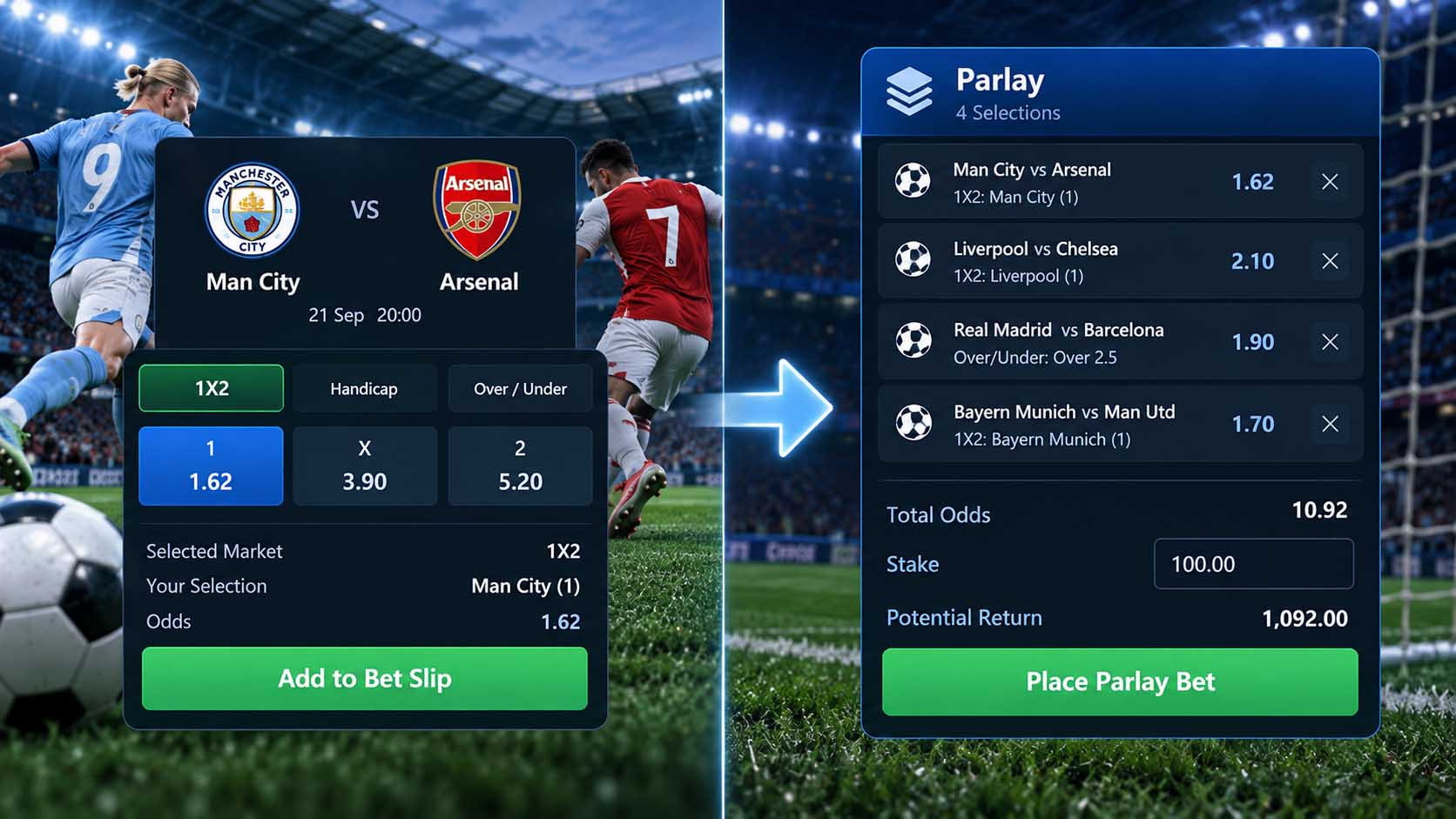
The main difference between a single bet vs parlay is how selections are organized. A single bet contains one independent selection, while a parlay combines two or more selections into one wager. With a parlay, the required selections generally need to succeed according to the applicable rules for the combined wager to succeed.
This structural difference affects how outcomes are evaluated and how odds from individual selections relate to the overall wager. Understanding it is useful before exploring more detailed football markets such as 1X2, handicap, and over/under.
What Is a Single Bet?
A single bet is built around one selection from one market.
For example, imagine a football fixture between Team A and Team B. A sportsbook might offer several markets for that match. If someone chooses one available outcome and treats it as an independent wager, that is a single selection.
Its result is evaluated separately from selections made on other matches.
The basic structure is:
One market → One selection → One independent wager
This simplicity makes single selections useful for understanding how sportsbook markets work. The reader only needs to identify the event, market, selected outcome, and associated odds.
What Is a Parlay?
A parlay combines multiple selections into one wager. The term accumulator is also commonly used for this general concept.
Instead of treating several selections independently, the parlay connects them.
For example, imagine selections involving three different football fixtures:
- Match A — one 1X2 selection
- Match B — one over/under selection
- Match C — one handicap selection
If those selections are grouped into one wager, they form a parlay rather than three independent single bets.
Generally, each required selection must satisfy its conditions for the combined parlay to succeed, subject to the specific rules that apply.
Single Bet vs Parlay: The Core Comparison
The easiest way to understand the difference is to compare their structures.
A single bet isolates one selection. A parlay connects several selections.
| Feature | Single Bet | Parlay |
|---|---|---|
| Number of selections | One | Two or more |
| Structure | Independent | Combined |
| Markets involved | One selection from a market | Can combine multiple eligible selections |
| Evaluation | Based on one selection | Depends on the combined selections |
| Odds structure | Based on one selection | Reflects the combined structure |
This distinction is more important than the particular football market being used.
A 1X2 selection can be placed independently or potentially included as one component of a parlay. The same principle can apply to eligible selections from other markets.
Therefore, “single” and “parlay” describe how selections are organized, while terms such as 1X2 and over/under describe what the individual markets evaluate.
How Individual Football Markets Fit Into a Parlay
A football sportsbook can present many market categories for a single match.
Common examples include match-result markets, handicap lines, and goal totals. Each market asks a different question about the event.
For readers exploring football betting information, this distinction is important because a parlay does not replace the meaning of the underlying markets. Instead, it combines eligible selections that already have their own conditions and outcomes.
Consider a simple hypothetical combination.
The first selection could concern the result of one match. The second might concern whether the goals in another match finish above or below a specified total. A third could involve a handicap line.
Although these selections are grouped together, each must still be understood according to its original market.
Why Parlay Selections Need to Be Read Individually
A common mistake is to focus on the combined parlay without first understanding each component.
A clearer approach is to examine every selection independently before considering the complete combination.
For each selection, identify:
- The sporting event.
- The market type.
- The selected outcome.
- The market conditions.
- The associated odds.
Only after these elements are clear should the selections be considered as one combined parlay.
This method matters because two selections may both concern football while operating under very different market rules.
A match-result selection, for instance, does not work in the same way as an over/under selection simply because both appear on the same parlay ticket.
How Odds Differ Between Singles and Parlays
Every sportsbook selection can have associated odds.
With a single bet, the relevant pricing relates to that individual selection.
With a parlay, the selections are combined, so the overall odds reflect the combined structure according to the sportsbook’s applicable calculation and rules.
This is one reason a parlay should not be interpreted merely as several single bets displayed together. The selections have been connected within one wager.
However, odds should not be treated as a prediction or guarantee of a result. They represent pricing attached to defined market outcomes.
A Simple Single vs Parlay Example
Suppose three football matches are scheduled.
A person identifies one selection from each fixture.
If each selection is kept separate, there are three independent single bets. The result of the first does not automatically determine the result of the second or third.
If all three are combined into one parlay, the relationship changes. The selections now form components of one wager.
This can be represented simply:
Singles
Selection A → independent
Selection B → independent
Selection C → independent
Parlay
Selection A + Selection B + Selection C → one combined wager
The football matches have not changed. The underlying markets have not changed either. What has changed is the way the selections are grouped.
Does a Parlay Have to Use the Same Market Type?
Not necessarily. Depending on the markets available and the applicable platform rules, a parlay may contain eligible selections from different market categories.
For example, selections might involve a match result, a goal-total market, and a handicap market.
This is why understanding football terminology remains important even when the main topic is parlay betting. The combined wager is only as understandable as its individual components.
Users should also check the applicable platform rules because eligibility and settlement conditions can differ by market and service.
Is a Parlay the Same as an Accumulator?
The terms are commonly used to describe the concept of combining multiple selections into one wager.
Terminology can vary between regions and sportsbook interfaces, so users may encounter “parlay,” “accumulator,” or abbreviated terms associated with combined selections.
The underlying idea remains that several selections are connected rather than treated as separate independent wagers.
Why the Difference Matters
Understanding single bets and parlays helps clarify the wider structure of sportsbook information.
A football fixture contains markets. A market contains available selections. Those selections can be treated independently or, where eligible, combined.
The semantic relationship is:
Football → Match → Market → Selection
From there, the wager structure can branch into:
Selection → Single bet
or
Multiple selections → Parlay
This separation makes sportsbook terminology easier to understand because it distinguishes the market itself from the way selected outcomes are grouped.
Reading Combined Selections More Clearly
When looking at a parlay, start with the individual selections rather than the combined odds.
Check what event each selection belongs to. Identify whether it uses 1X2, handicap, over/under, or another market. Then determine what outcome must occur under that market’s conditions.
After every component is understood individually, examine how they work together as a parlay.
This approach provides a clearer understanding of single bet vs parlay structures. A single bet keeps one selection independent, while a parlay connects multiple selections into one combined wager. The distinction is ultimately about organization: the underlying football markets define the outcomes, while the wager structure determines whether those selections stand alone or operate together.