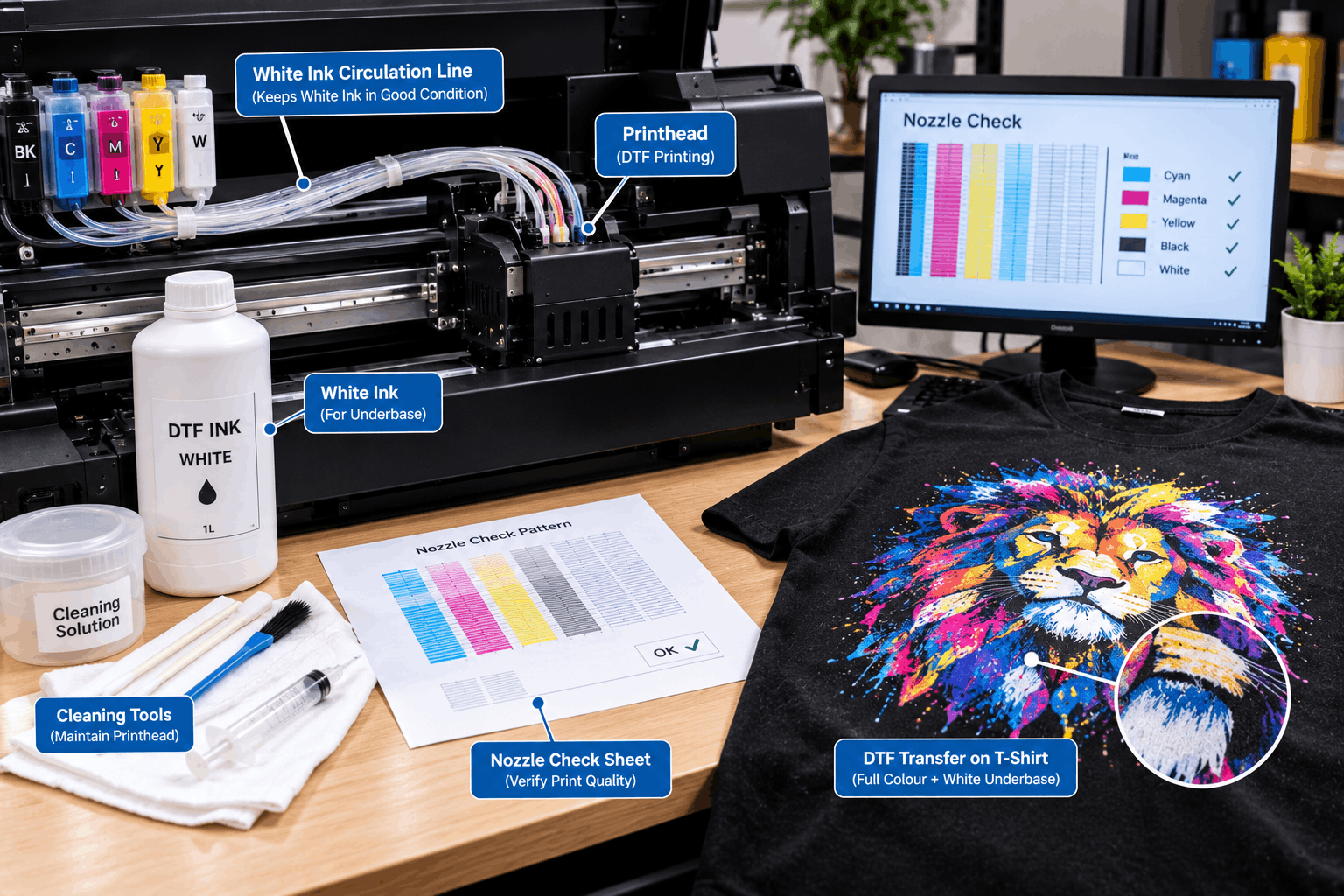
White ink in DTF printing needs special care because it contains a high concentration of pigment that can settle when left still. If the ink system is not managed correctly, this settling can contribute to inconsistent ink flow, missing nozzles, weak white coverage, or printhead blockages. Regular circulation, cleaning, and correct printer use help reduce these problems.
White ink is also essential to many DTF transfers. It forms the opaque layer behind coloured artwork, especially when a design is applied to dark or coloured fabric. That makes reliable white ink management an important part of everyday DTF production.
Why Is White Ink Important in DTF Printing?
DTF printing commonly uses CMYK inks to create the colour portion of a design. White ink serves a different purpose.
It creates a white underbase behind the coloured image. This layer helps prevent the garment colour from showing through the artwork.
Consider a colourful logo transferred onto a black T-shirt. Without an effective white layer, some colours may appear less visible against the dark fabric.
The white underbase gives the colour layer an opaque foundation.
This is why white ink is not simply an optional extra in many DTF workflows. It plays a functional role in producing transfers for dark and coloured garments.
Why Does White Ink Require More Attention?
White ink contains suspended pigment. When the ink remains still, heavier pigment can gradually settle.
This characteristic creates a different maintenance challenge from standard colour inks.
If pigment distribution becomes uneven, the printer may not receive white ink consistently. Over time, poor ink movement can contribute to problems within the ink path or printhead.
That is why many DTF workflows include some form of regular white ink management.
The goal is to keep the ink in suitable condition and maintain consistent flow through the system.
Why Does White Ink Clog DTF Printers?
Several conditions can contribute to white ink flow or nozzle problems. These can include prolonged idle periods, inadequate maintenance, dried ink around key components, or pigment settling.
The problem is not always caused by one factor.
For example, a printer that remains unused for an extended period may need different care from a machine operating regularly. Environmental conditions and maintenance routines can also affect how the ink system behaves.
Therefore, users should follow the maintenance procedures designed for their specific printer.
Trying random cleaning methods can create additional problems. Printer components are delicate, and unsuitable cleaning products or aggressive handling may cause damage.
How Does White Ink Circulation Help?
A white ink circulation system is designed to keep white ink moving through relevant parts of the ink system.
Movement can help reduce pigment settling during normal operation. It supports a more consistent supply of white ink compared with allowing pigment-heavy ink to remain completely stationary for long periods.
For anyone comparing a direct-to-film printer, white ink management is therefore worth examining alongside print size, software, maintenance access, and workflow requirements.
However, circulation should not be confused with zero maintenance.
Even equipment with white ink circulation can require nozzle checks, cleaning, inspection, and proper shutdown or idle-time procedures.
White Ink in DTF Printing Still Needs Routine Maintenance
Regular maintenance helps identify small problems before they interfere with production.
The exact routine depends on the printer. However, users may need to monitor several areas.
Perform Nozzle Checks
A nozzle check provides a quick view of whether the printhead is firing correctly.
If part of the white pattern is missing, the operator can investigate before starting an important production run.
This is useful because a white ink problem may not always be obvious when looking only at the colour portion of a design.
Keep the Capping Area Clean
The capping station is an important part of many inkjet maintenance systems. Ink residue or contamination around this area can interfere with normal printer care.
Follow the manufacturer’s instructions when cleaning it.
Inspect the Wiper
The wiper helps maintain the printhead surface on many printer designs. Excess dried ink or debris can affect its ability to work correctly.
Again, cleaning should follow the recommended method for the specific machine.
Monitor Ink Condition
White ink should be stored and handled according to the ink supplier’s instructions.
Avoid assuming that all DTF inks have identical storage requirements. Using compatible ink is also important because the printer, ink, film, powder, and curing process operate as a connected system.
What Happens When White Ink Is Not Flowing Correctly?
White ink problems can appear in several ways.
A transfer may show weak white coverage. Some areas may look uneven, or parts of the design may appear less opaque than expected.
A nozzle check may also reveal missing sections.
However, visible print defects do not automatically prove that white ink settling is the only cause. Similar symptoms can involve printhead condition, maintenance issues, software settings, ink supply, or other parts of the workflow.
A useful troubleshooting approach is to check one stage at a time rather than changing several settings at once.
Start with the nozzle check and basic maintenance condition. Then review ink flow and software settings according to the equipment documentation.
Why Idle Time Matters
DTF printers are production equipment, and periods of inactivity need to be considered.
A machine used regularly may follow one maintenance routine. A printer that will remain unused for several days or longer may require a different procedure.
This matters particularly with white ink because pigment settling and ink drying can become more relevant when the system remains stationary.
Before buying equipment, ask what maintenance is required during:
- normal daily operation;
- overnight idle periods;
- weekends;
- longer periods without printing.
Knowing these requirements helps a small business decide whether the printer suits its actual working schedule.
Can Automatic Cleaning Prevent Every White Ink Problem?
Automatic cleaning features can support printer maintenance, but they do not remove the operator’s responsibilities.
The printer still needs appropriate ink, correct operating conditions, regular inspection, and the maintenance specified by its manufacturer.
Automated functions are best viewed as part of the maintenance system rather than a substitute for it.
The same principle applies to white ink circulation. It can support ink management, but it cannot compensate for poor maintenance indefinitely.
White Ink Management Should Be Considered Before Buying
Beginners often compare DTF printers by print width, resolution, speed, or purchase price. White ink management deserves similar attention.
Before choosing a machine, find out how its ink system works. Check whether it has a circulation method and learn what maintenance the printhead requires.
Also ask how the printer should be handled during idle periods.
These details can matter in everyday use because DTF printing depends on reliable colour and white ink output.
A suitable printer should match not only the designs you want to produce but also the maintenance routine you can realistically follow.
Consistent White Ink Starts With Consistent Care
White ink needs special attention because its pigment can settle and because it performs an important role in DTF transfers. Reliable white output depends on more than simply filling an ink tank and starting a print job.
Proper ink circulation, nozzle monitoring, routine cleaning, correct storage, and suitable idle-time procedures all contribute to a more manageable workflow.
By understanding white ink before operating a DTF printer, users can build maintenance into their normal production routine rather than waiting for visible print problems to appear.