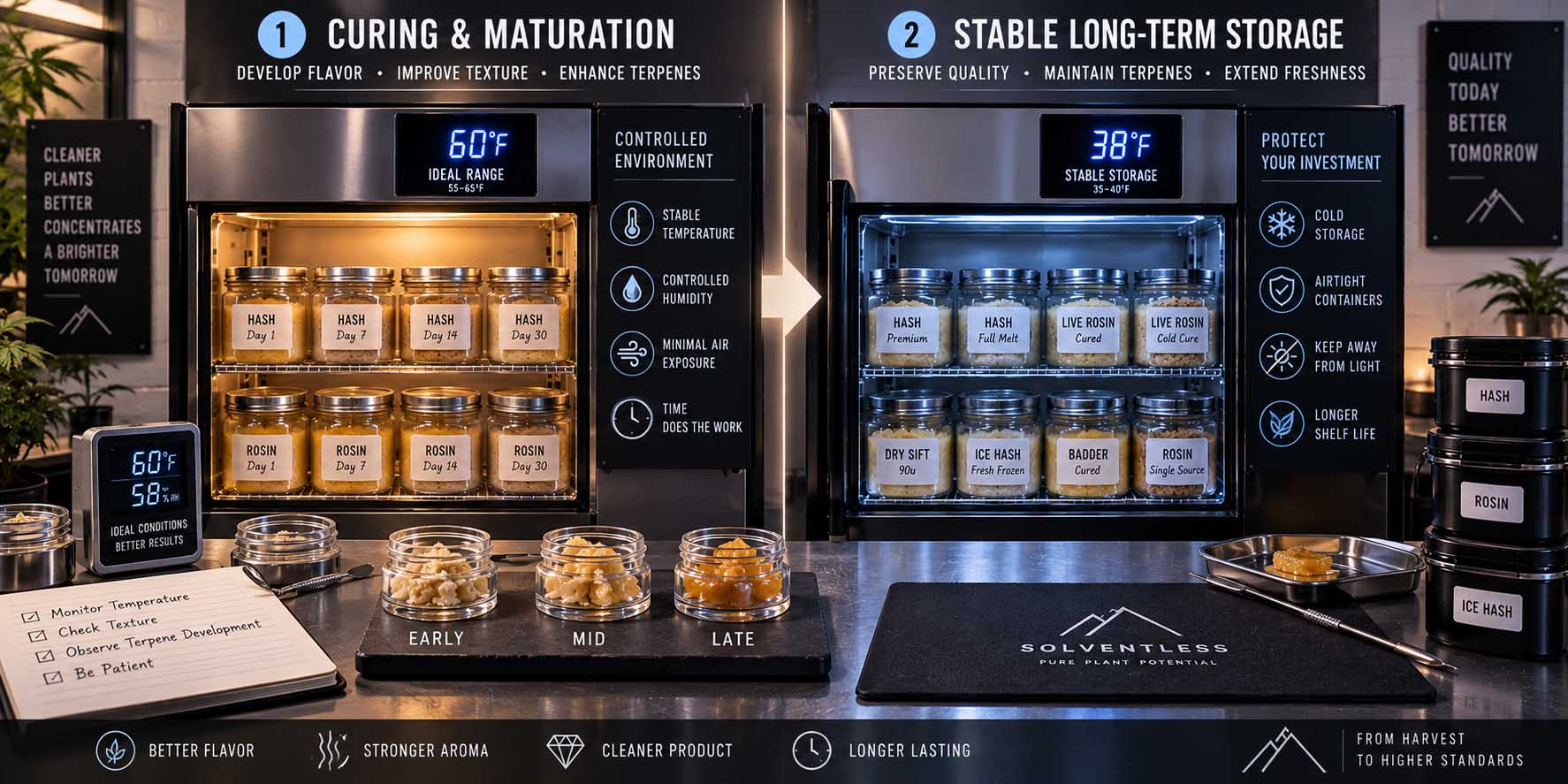
The main difference between curing vs storing cannabis concentrates is the purpose of each stage. Curing intentionally keeps hash or rosin under selected conditions so the resin can develop or stabilize, while storage focuses on maintaining a concentrate after it has reached the desired condition. Both may involve controlled temperatures and sealed containers, but they serve different roles in a professional post-harvest workflow.
Understanding this distinction is useful because putting a concentrate in a cool environment does not automatically mean it is being stored. If temperature and time are being deliberately used to influence the material, it may still be undergoing curing.
What Does Curing Cannabis Concentrates Mean?
Curing is a controlled post-processing stage.
For hash and rosin, processors may use selected temperature conditions over time to manage how the resin develops. The exact approach varies according to the concentrate, starting material, desired consistency, and processing method.
Cold curing, for example, uses cooler controlled conditions. Hot curing deliberately introduces greater warmth. Although the methods differ, both use temperature as an active part of the processing environment.
This is what separates curing from simply putting finished material away for later use.
The processor expects something to happen during curing. The resin may stabilize or develop toward a desired physical condition before moving to the next stage.
What Does Storing Cannabis Concentrates Mean?
Storage generally begins when intentional development is no longer the main objective.
Instead, the processor wants to maintain the concentrate’s existing condition and protect it from unnecessary environmental changes.
A storage strategy may consider several factors:
- Temperature stability
- Direct light exposure
- Air exposure
- Container quality
- Moisture and condensation
- Frequency of access
- Storage duration
- Handling during temperature transitions
Therefore, storage is not simply about making hash or rosin cold. It is about creating conditions appropriate for maintaining the finished or intermediate material.
Curing vs Storing Cannabis Concentrates: The Key Difference
A simple question can distinguish the two stages:
Do you want the concentrate to continue developing, or do you want to maintain its current condition?
If controlled temperature and time are being used to encourage intentional development, the process is curing.
If the material has reached its desired state and the goal is to minimize further unwanted change, the process is storage.
Consider freshly pressed rosin. A processor may place it under selected conditions specifically to develop a particular consistency. That is a curing process.
Once the desired condition has been reached, the same material may move into controlled storage so it can be maintained until packaging, use, sale, or further processing.
The concentrate may even remain in similar equipment, but the objective has changed.
Why Temperature Control Matters During Curing
Temperature is one of the central variables in concentrate curing because resin responds physically to changing environmental conditions.
However, successful temperature management is not simply a choice between “hot” and “cold.” Stability and repeatability matter as well.
Professional operators may need to process several batches using comparable procedures. If ambient conditions vary significantly from one batch to another, reproducing a curing method can become more difficult.
This is where purpose-built cannabis curing equipment can fit into a professional workflow, particularly when processors need controlled conditions for curing rather than relying only on general-purpose refrigeration.
The equipment should support the intended process. A system selected for curing may therefore need different capabilities from an appliance used solely for cold storage.
Why Temperature Matters Differently During Storage
During storage, temperature is generally used to help maintain the material rather than intentionally encourage development.
Consistency remains important.
Repeatedly moving concentrates between substantially different environments can expose them to temperature cycling. Cold containers also require thoughtful handling when they are brought into warmer surroundings.
For example, a container removed from a cold environment can remain considerably colder than the surrounding air. In humid conditions, condensation may form on cold surfaces.
Keeping an appropriate container sealed while it adjusts to the new environment can help manage unnecessary moisture exposure.
This demonstrates why professional storage involves both equipment and handling procedures.
Can the Same Equipment Be Used for Curing and Storage?
Potentially, yes.
Some systems can support multiple temperature-controlled post-harvest functions. However, the ability to use one piece of equipment for both purposes does not make curing and storage identical.
The operator still needs to define the objective at each stage.
The iCure Hash Fridge is positioned around hash and rosin workflows that can include hot curing, cold curing, and controlled storage. In a workflow like this, equipment can support different stages while the processor changes conditions according to what the material requires.
This integrated approach can be useful when the processing operation wants to move concentrates from active curing toward controlled storage without treating every stage as the same process.
How Containers Support Curing and Storage
Containers are important in both stages, but they should be considered alongside temperature and handling.
During curing, the container provides a controlled space around the concentrate while the material develops. The processor may also need to inspect the material at appropriate points without exposing it unnecessarily.
During storage, the emphasis shifts toward maintaining the material with minimal disturbance.
Suitable containers can help limit unnecessary interaction with surrounding air and moisture. They can also make batches easier to organize, label, move, and monitor.
Container size matters as well. Professional processors may prefer separating material into practical batch quantities rather than repeatedly opening a large container whenever a small amount is required.
Where Does Maturation Fit?
Maturation and curing can overlap conceptually because both describe development occurring over time.
Terminology may differ between processors and products, so the objective is often more informative than the label.
A processor can ask:
What is happening to the concentrate now?
If the material is intentionally being allowed to develop under selected conditions, the stage belongs broadly within curing or maturation.
If the desired condition has already been achieved and environmental control is being used primarily to maintain it, the process has shifted toward storage.
This distinction makes post-harvest procedures easier to document and reproduce.
Where Do Curing and Storage Fit in Solventless Processing?
Curing and storage are downstream stages within a larger solventless processing chain.
For ice-water hash, a simplified workflow may look like:
Cannabis material → ice-water washing → trichome collection → filtration → drying → curing or further processing → storage
If the hash will be pressed into rosin, additional stages can follow:
Dried hash → rosin pressing → curing or maturation → controlled storage
Not every concentrate follows exactly the same sequence. Nevertheless, the model demonstrates that curing and storage should not be viewed in isolation.
What happens during washing, drying, pressing, and handling can affect the material entering the curing stage. Likewise, storage procedures matter after curing is complete.
Curing Equipment vs Storage Equipment
Equipment should be selected according to its role in the workflow.
A basic storage system may only need to maintain appropriate conditions for finished material. A curing system may need to support a broader range of controlled environments because temperature is being actively used as part of processing.
Before selecting equipment, operators can consider:
- Whether they need cold curing
- Whether their workflow includes hot curing
- Whether finished concentrates also need controlled storage
- How many batches will be handled simultaneously
- Required temperature-management capabilities
- Container sizes and organization
- Frequency of equipment access
- How material will move to the next processing stage
These practical requirements provide a better basis for equipment selection than simply choosing an appliance because it can cool concentrates.
When Does Curing Become Storage?
Curing becomes storage when the processor’s objective changes from intentional development to preservation.
There is no single universal time at which this occurs for every concentrate. Different hash and rosin products may require different workflows.
Instead, the transition should be based on the intended result.
Once the material has reached the condition the processor wants, continuing to expose it to curing conditions without a purpose may no longer be necessary. At that stage, storage conditions can be selected to maintain the product appropriately.
This objective-based approach is especially useful for professional operations because it creates clear stages that staff can follow.
Why Separating the Two Stages Improves Workflow Control
Clearly distinguishing curing from storage makes post-harvest procedures easier to organize.
Processors can define what conditions apply during active development, establish criteria for moving material into storage, and create handling procedures for accessing cold concentrates later.
It also prevents a common conceptual mistake: assuming that all refrigeration is curing or that all time spent in a controlled environment is storage.
Curing vs storing cannabis concentrates is ultimately a distinction between intentional development and preservation. Curing uses selected environmental conditions to help hash or rosin develop or stabilize toward a desired state, while storage focuses on maintaining the material after that state has been reached. Treating them as separate but connected stages creates a clearer and more controlled post-harvest workflow.